Choosing a Legal SEO Agency: 10 Steps to Protect Your Retainer

The pieces of a defensible decision are dull and specific. You want baseline numbers you recorded yourself and evidence you can check without the agency's help. You also want reporting you can read without a translator and goals written in qualified intakes rather than visit counts.
Choosing a Legal SEO Agency Starts With Your Own Numbers
Vendor evaluation begins inside your own firm. If you don't know what your search presence produces today, you can't price the improvement anyone promises tomorrow.Step 1: Record a Reliable Search and Intake Baseline
Pull at least the previous six months of data before the first sales call, and export it somewhere the agency cannot edit. In Google Analytics 4 (GA4), record organic sessions and the landing pages that received them. In Google Search Console, save impressions and clicks alongside average query positions for the terms that matter to your practice.Then move to the phone and the front desk. Log Google Business Profile calls and direction requests. Track calls and form submissions separately, because the two behave differently. Count qualified consultations and signed matters on their own, and record revenue or projected case value where that is ethically and operationally appropriate for your practice.
Not every ring is a lead. A wrong number isn't an intake, and neither is a caller in a state where you aren't licensed or a solicitation from another vendor. Firms that rely on raw call volume alone may overestimate marketing performance when many of those calls are not qualified leads.
Define your conversion rates in writing. A website conversion rate might divide tracked inquiries by website sessions, while an intake conversion rate might divide signed matters by qualified inquiries.
Use consistent conversion definitions when comparing performance over time, and document any changes so they do not distort reported growth.
Step 2: Prioritize Practice Areas and Geographic Markets
Decide which matters you actually want before anyone runs keyword research on your behalf. A family law practice pursuing high-value divorce work needs a different plan than a personal injury firm expanding into the next county. An agency that can't tell the difference may hand you the content calendar it gives everyone.Write the commercial brief yourself. Start with average case value and current attorney capacity. Geographic reach comes next. Last is the unglamorous question of whether your intake staff answers the phone at 6 p.m. on a Friday. Volume you can't service isn't growth; it's a queue of unhappy callers.
Online visibility can begin the search process, but starting a search and hiring a lawyer are separate behaviors. Strong rankings can generate opportunities, but an intake process that cannot qualify or respond to prospects can undermine those gains.
Test the Provider's Record, Not Its Pitch
Contract terms matter, but they come after proof. Narrow the field first, then make each survivor show its work.Step 3: Screen for Legal Specialization
Specialization matters for practical reasons. A provider experienced with law firms may be more familiar with practice-area economics, local competition, and the advertising rules that affect legal marketing. Firms should verify that expertise and specialization.Ask what share of the provider's clients are law firms and what the rest of the roster looks like. Generalists can do good work; a law-firm-focused client list can indicate relevant industry experience. Ask how the provider handles advertising rules and attorney review rather than assuming familiarity.
One example of a provider focused specifically on the legal sector is RizeUp Media. The company offers SEO services for law firms, web design, paid advertising, local services ads, and social media marketing.
The RizeUp Media website also states that it does not require long-term contracts and describes its process as starting with a discovery call followed by a growth roadmap outlining recommended actions, investment, and a timeline.
Step 4: Audit Case Studies Behind the Headline Numbers
A useful case study should provide enough context to evaluate the result, including the starting point, market, scope of work, measurement period, and, where available, business outcomes beyond traffic or rankings.If client confidentiality prevents naming the firm, ask for anonymized analytics exports instead. Redacted GA4 and Search Console exports can still provide useful evidence, such as date ranges, traffic or conversion data from GA4 and search-performance data from Search Console.
Then work through each example one claim at a time. Ask what the client's baseline was and which specific work caused the reported change. Did qualified inquiries and signed cases move, or only impressions? Also ask for the measurement period and data source.
A provider's willingness and ability to document those details can be an important part of the evaluation.
Step 5: Speak With References That Resemble Your Firm
Ask for two references that share something meaningful with your practice, such as the same practice area or a similar market size. A national brand reference may be less relevant to a three-attorney firm in a mid-sized county than a reference with a similar practice area, market, or budget.On the call, ask whether the monthly reports matched what the firm saw in its own intake logs. Ask how many account managers the firm has cycled through and how long a routine website change took to go live. Another useful question is whether performance shifted once the sales team handed off the account.
Reviews belong in this conversation too. A competent provider can describe its review-support process in plain terms, and that process must never involve fabricated reviews or steering unhappy clients away from public platforms.
Step 6: Inspect the Local Citation Plan
A local citation is an online reference to your firm's name, address, and phone number, often shortened to NAP. Consistency matters the moment something changes. Firms move offices and replace phone systems. They add attorneys and open second locations.Each change can leave outdated or inconsistent listings across directories and platforms, making accurate business information harder to maintain.
A workable local citation strategy for law firms names the directories being created or corrected and says who holds each profile login. It explains how duplicates will be removed rather than ignored, and it produces a monthly record of what changed and when.
Watch for fabricated offices and virtual addresses that do not meet the rules of the platforms where they are listed. Bulk directory submissions without a process for checking accuracy and correcting errors can create additional listing-management problems.
Examine the Work the Agency Will Control
Once an agency has access, it may be managing important parts of your firm's digital presence. Decide now what happens to those assets if the relationship ends.Step 7: Pin Down Who Controls the Website
Establish clear operational boundaries from day one. Explicitly designate who holds technical publishing rights and who handles legal review before any piece goes live. Furthermore, secure owner-level administrative access to your CMS for the duration of the vendor relationship, maintaining full control over user seats and site permissions.For marketing purposes, your website should make it easy for relevant visitors to become prospective clients. Practice-area pages and attorney biographies should be easy to find and easy to read. Reviews and every contact option should be, too.
Mobile behavior is less forgiving. Inspect the navigation on a phone before you sign anything. Load a practice-area page on a weak connection and submit the contact form yourself, then confirm that the tracking recorded a real submission rather than a page view that looks like one. Design alone doesn't sign cases, but a broken contact path can undermine the results the agency generates.
Settle ownership in writing before work starts. The website and its copy need a named owner after termination, and so do the design files, the call-tracking numbers, the analytics properties, and every login created in your firm's name.
Expose Reporting and Contract Red Flags
This is where you protect the budget. All three checks below are cheap to run before the first invoice clears.Step 8: Demand Visibility Into Backlinks and Content
A backlink is a link from another website to yours. Search engines can use links as signals for understanding relevance and the relationships between pages, making the quality and source of backlinks worth evaluating.Require disclosure at the link level. The report should name the source domain and the destination page, then state the acquisition method and publication date. It should also say whether the link was still live during the reporting period.
Some patterns deserve scrutiny at a glance. Google's spam policies prohibit links created primarily to manipulate rankings and specifically identify paid ranking links, automated link creation, and low-quality directory links as examples of link spam.
An agency that will not disclose backlink sources should prompt further scrutiny, especially if the firm cannot independently evaluate the quality or risk of those links.
Keep approval rights over anything published in your firm's name. Consider requiring attorney review of legal claims, jurisdiction-specific statements, attorney credentials, and descriptions of past case outcomes before publication.
Step 9: Require Reporting That Connects Search to Intake
Ask to see an anonymized real-client report rather than a sales-built sample template. Useful SEO reporting metrics for law firms separate leading indicators from business outcomes, and that distinction is not cosmetic.Leading indicators tell you whether the work is landing. Impressions and clicks belong in that bucket, along with local profile actions and engagement on organic landing pages. Business measures are what pay for the retainer. Qualified calls and booked consultations sit there, along with retained matters and cost per signed case.
Search is often where a prospective client starts researching a legal problem, but it may not be the last step before they call. A report that stops at impressions leaves the most expensive question unanswered.
Ask the provider to state its attribution limits in plain language. Someone may find your firm through a search in March and call in June, after reading reviews or hearing your name from a neighbor. Honest reports document that uncertainty instead of claiming perfect attribution.
Skip the universal growth percentages. Your targets should reflect your own baseline and capacity, along with what a matter is worth once your intake process has qualified it.
Step 10: Put 90-Day Goals and Exit Rights in Writing
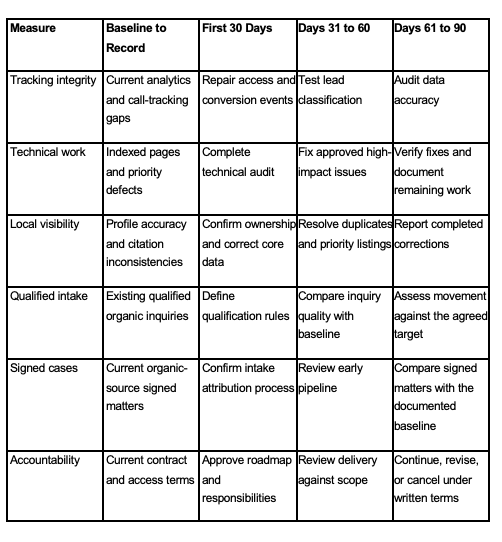
Sensible 90-day law firm SEO goals measure implementation and early business signals, not a ranking position on a date certain. Nobody controls the algorithm. Use the scorecard below as a structure and fill the targets with your own numbers.Skip the universal growth percentages. Your targets should reflect your own baseline and capacity, along with what a matter is worth once your intake process has qualified it.
Then watch for the law firm SEO contract red flags. Guaranteed rankings are the clearest, given who controls the algorithm. Undisclosed subcontracting comes next. Vague deliverables that never specify volume or scope belong on the list. Another major red flag is a cancellation term that undermines the ownership established in Step 7.
Choose the Provider That Makes Its Work Inspectable
Strip out the sales language, and the decision gets simpler. A provider worth a retainer can say what it will do in specific terms and show you where that work appears once it's done.It keeps appropriate accounts and assets under your firm's control and reports both search-performance indicators and meaningful intake outcomes. A provider that resists reasonable transparency around those terms deserves closer scrutiny.
Sign with the provider whose evidence and access terms you can read before the first retainer payment clears and whose 90-day scorecard you could question line by line.
Do You Need An Attorney?
If so, post a short summary of your legal needs to our site and let attorneys submit applications to fulfill those needs. No time wasted, no hassle, no confusion, no cost.
Posted - 09/03/2026
Connect with us:
Learn about us: