Pennsylvania Workers’ Comp Deadlines: When a Philadelphia Workers Compensation Lawyer Can Help

What follows is general Pennsylvania legal information. It can't tell you your filing date.
Pennsylvania's Four Workers' Comp Clocks Are Not Interchangeable
Here's the short version. Notify your employer within 21 days, and benefits can date back to the injury; report within 120 days at the latest, or the claim can die. From there, the employer or insurer has 21 days after learning of the injury to issue payment or denial paperwork, and you generally have three years to file a claim petition. These duties come from the Pennsylvania Workers' Compensation Act.Those clocks rarely line up neatly. Pinning down which one governs your situation, and when each one started running, is case-specific work a Philadelphia workers' compensation lawyer can do using your medical and employment records before any deadline passes.
The 21-day notice window affects when compensation may begin
Report your injury immediately. Section 311 ties benefits to how fast you report: notice within 21 days preserves compensation beginning with the injury date, provided you meet other benefit requirements. If you report later, but still within 120 days, you generally lose compensation for the period before your notice. Reaching day 22 doesn't kill your claim on its own. Say what the injury was, that it happened at work, and roughly when and where; a written notice records what you told them.The 21-day window governs when benefits begin, not when you must file your claim.
The 120-day limit can bar benefits
Section 311 generally demands notice within 120 days, though the employer's actual knowledge can satisfy the requirement. The discovery language can move the clock's start point when the injury, or its work connection, wasn't reasonably known. Fraud, deceit, or misrepresentation by an employer needs case-by-case review. Don't presume it buys you extra time. Weak notice can wipe out everything, including past benefits. Save every message that shows what your employer knew.The insurer's 21-day response period is its own clock
Once the employer or insurer receives notice or knowledge of the injury, Section 406.1 generally gives it 21 days to take formal action. What should land on your desk is a Notice of Compensation Payable, a Notice of Temporary Compensation Payable, or a Notice of Workers' Compensation Denial. Silence is not approval, and it won't push your filing period out indefinitely. Ask for copies of the forms themselves.The general claim-petition period is three years
Section 315 bars a claim petition, as a general rule, unless it's filed within three years of the injury. An employer incident report is not that petition. Talking to an adjuster isn't a filing either. A denial creates no fresh limitation period. Prior compensation payments can change the math, though not every medical-bill payment restarts the clock; payment type and procedural posture both matter. Check the payment history against your petition filing confirmation date.Notice and a Claim Petition Do Separate Work
Notice tells the employer a work injury occurred
Notice puts the employer on record that a specific injury happened in connection with employment. Section 312 governs its substance. A useful written report includes:- The date notice was delivered
- The approximate injury date or exposure period
- The body part or condition involved
- The work activity believed to have caused it
- The recipient's name and position
A casual word to a coworker doesn't count. Section 313 spells out the proper recipients, including supervisors and designated employer representatives. Oral notice might pass muster, but writing leaves proof of who received it and when.
A claim petition asks the system to award benefits
Notice alerts the employer. A petition demands action. A claim petition asks a Pennsylvania workers' compensation judge to award disputed benefits through the Act's adjudication process. Completing one doesn't complete the other. You carry the burden of proving a compensable injury and resulting disability, as the Pennsylvania Supreme Court laid out in Inglis House v. WCAB (Reedy), 634 A.2d 592 (Pa. 1993). Prompt reporting doesn't spare you the petition when benefits stay disputed.The Math Gets Harder When Your Injury Has No Accident Date
Repetitive trauma may involve a disputed injury date
Carpal tunnel syndrome and gradual hearing loss develop without one identifiable accident. Repeated lifting can aggravate existing conditions in the same way. Your last day worked is not, by default, the legal injury date. We must weigh the medical evidence and work history against the disability and the theory pleaded in your petition.Occupational disease claims add a 300-week rule
Section 301(c)(2) generally requires occupational-disease disability or death to occur within 300 weeks after the last employment in the occupation involving the exposure. That coverage requirement stacks on top of the notice and petition deadlines. Several clocks can run at once; never calculate your filing date from the last-exposure date alone.A minor-seeming injury gets no bonus time
Plenty of workers expect the pain to pass. Betting on that is risky. Pennsylvania preserves retroactive compensation if an employee injury is reported within 21 days and generally bars the claim entirely if it is not reported within 120 days of the injury, subject to stated exceptions. The Act's discovery language distinguishes an injury or work relationship you didn't reasonably know from a known injury you considered unimportant. Your early descriptions of the pain may matter.Medical records can help establish when the condition became identifiable
Your first documented symptoms and a physician's work-causation opinion help establish when the condition became identifiable. Work restrictions may document disability. Employment records can show your last exposure to the harmful activity.A Decision Chart for Common Situations
This chart applies the distinctions above to frequent scenarios. It offers a conservative next step; an individualized deadline calculation requires the underlying documents, and a disputed date or payment history deserves a closer look.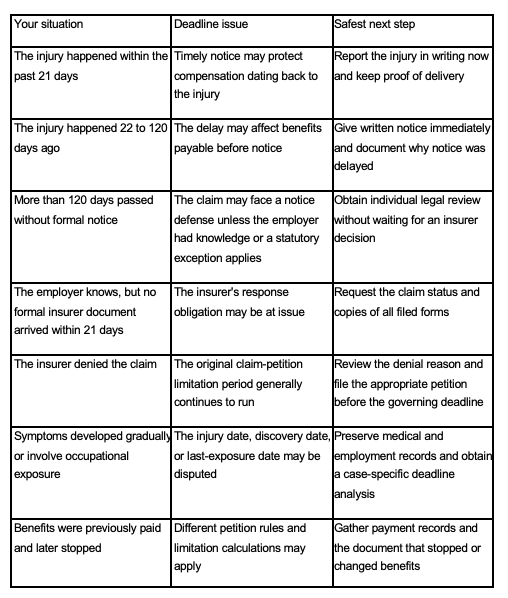
If a row points to individual review, act on it. Waiting for the insurer's next move wastes time you may not have.
After a Pennsylvania Workers' Comp Denial
A denial does not reset the filing period
Denied? Section 315 still requires a claim petition within three years of the legally recognized injury date. Waiting for an adjuster to reconsider burns time without preserving your claim. A denial isn't a petition.The denial reason tells you which evidence matters
A denial may dispute that your injury occurred at work, that you provided timely notice, or that you suffered wage loss. It states a position you can contest through adjudication, not proof of insurer fraud. Line up the stated reason with your supporting records.Filing opens a case; it doesn't order payment
Under Pennsylvania's adjudication process, filing leads to assignment before a workers' compensation judge. Hearings involve testimony and other evidence, and mediation may occur. Filing itself orders nothing. Case complexity and local calendars drive timing, so keep your petition confirmation and case number.Official Pennsylvania Resources for Checking a Claim
Pennsylvania Department of Labor and Industry
The Pennsylvania Department of Labor and Industry's workers' compensation program provides forms, program guidance, adjudication information, and office contacts for procedural questions.Workers' Compensation Office of Adjudication
The Workers' Compensation Office of Adjudication handles disputed cases. Your case documents list your assigned venue. An informal agency inquiry does not constitute a filing.When a Philadelphia Workers' Compensation Lawyer Needs to See Your Dates
Individual review matters most near a deadline. Continued repetitive work after symptoms began, or a physician's delayed disease attribution, often means comparing medical and employment records line by line. Employer-knowledge disputes turn on earlier communications. Temporary compensation and other payments deserve separate scrutiny, especially if negotiations continued past a denial. Weigh conflicting incident and treatment dates against when the disability began. Don't wait to resolve every discrepancy. Counsel cannot promise to revive a barred claim; bring the earliest records and payment documents you have.Pennsylvania Workers' Compensation Deadline FAQs
How long can a Pennsylvania worker wait before reporting an injury?
Report within 21 days, and generally no later than 120 days, subject to Section 311's qualifications. Late notice can cost you retroactive compensation. Past the outer limit, missing notice can defeat compensation unless employer knowledge or another recognized exception applies.Does a denied Pennsylvania workers' comp claim get a new deadline?
No. The denial date records the insurer's decision, nothing more. Your injury date still controls the three-year petition period under Section 315. Keep both dates distinct on your timeline.Which Philadelphia workers' comp lawyer is best for a deadline dispute?
No objective "best" lawyer fits every case. Look for substantial Pennsylvania workers' compensation experience and regular local appearances. Ask how counsel would resolve conflicting medical and employment dates, and ask for a written fee agreement in plain terms.What is the most a Pennsylvania workers' comp lawyer can charge?
Section 442 requires approval of attorney fees and generally treats up to 20 percent as reasonable. A judge can approve more, but only for good cause; 20 percent isn't an absolute statutory ceiling. The approved agreement and case order control. Litigation costs sit outside the fee.What should a worker avoid saying to the insurer?
Don't guess about dates or medical causation. Describe symptoms and limitations accurately, neither minimizing nor exaggerating. Be truthful about earlier injuries, separate uncertainty from knowledge, and ask for clarification when a question is vague. None of that means dodging legitimate communications or required examinations.What are the odds of winning a Pennsylvania workers' comp case?
No reliable percentage predicts an individual result. Section 311's notice requirements and the claimant's burden from Inglis House demand case-specific evidence. Credible testimony must align with the medical-causation evidence and disability proof, and procedural compliance matters too.Which workplace injuries are hardest to prove?
No diagnosis holds that title. Gradual conditions and largely subjective symptoms require thorough medical documentation. Under the Inglis House burden, your evidence must establish a compensable work injury and resulting disability, not merely the presence of symptoms.Protect the Record While the Clock Runs
Notice and petition filing are separate acts, and the insurer's response obligation does not replace either. Report the injury in writing, preserve the documents, and find out early whether your situation needs a petition. The record you build now will shape any deadline dispute.Do You Need An Attorney?
If so, post a short summary of your legal needs to our site and let attorneys submit applications to fulfill those needs. No time wasted, no hassle, no confusion, no cost.
Posted - 10/15/2026
Connect with us:
Learn about us: